Logging in to OpenSea and Navigating Collections: What NFT Traders in the U.S. Really Need to Know

Imagine you’re at your desk, coffee cooling, ready to buy a 1/1 Coldie drop you’ve been watching. You open OpenSea, but the familiar “Log in” flow looks different than last month: wallet prompts, a Seaport offer, and a banner about stablecoin support. Small frictions like which wallet to connect, what chain the collection lives on, and whether royalties apply can turn a quick purchase into a costly mistake. This piece unpacks the mechanics behind OpenSea login and collections, clears common misconceptions, and delivers practical heuristics you can use before you hit “confirm.”

The goal isn’t a step-by-step how-to; it’s to make you predictable and deliberate. Knowing what happens when you sign in, how collections are structured, and where the platform’s limits lie changes decisions from guesswork to informed risk-management. I’ll also point out useful indicators to watch as the marketplace and regulation evolve in the U.S.

OpenSea logo indicating marketplace identity; useful when verifying correct site during login

How OpenSea login actually works (non-custodial mechanics and practical implications)

“Logging in” on OpenSea is not like signing into a web app with username and password. Mechanically, the platform uses wallet connection: you present a cryptographic signature from your third-party wallet (MetaMask, Coinbase Wallet, or an email-based wallet) to prove control of an address. OpenSea does not take custody of funds—your keys and accounts remain with your wallet provider.

Why that matters: because custody equals liability. If your seed phrase is lost or stolen, OpenSea has no ability to recover assets. This non-custodial design reduces platform risk but transfers operational risk to you. For U.S. users this means traditional recovery tools (like “forgot password”) don’t exist; plan accordingly: hardware wallets, secure seed storage, and tested recovery procedures are essential.

There are trade-offs. A non-custodial login keeps the blockchain model intact—transactions are executed on-chain—but it also creates friction for newcomers. OpenSea mitigates this by offering email-based wallet creation. That’s convenient but subtly different in risk profile: email-based wallets introduce custodial recovery vectors (email security) and may not be suitable for high-value holdings.

Collections: structure, metadata, and the real governance

When you browse a collection on OpenSea you see art, floor prices, traits, and activity—this inventory is built from token metadata that typically lives on-chain or via decentralized storage. Collections are not curated moderation boards; they are token groupings—smart contract addresses and associated metadata templates. This distinction is important when you evaluate provenance and authenticity.

Common misconception: “A collection’s presence on OpenSea guarantees authenticity.” It does not. OpenSea can delist or hide NFTs involved in scams or IP disputes, but metadata and token contracts are still on the underlying blockchain. The platform’s content moderation can remove visibility but not the on-chain existence. In practice, verify creator addresses, contract source, and launch mechanisms (Seadrop for many primary sales) before high-value buys.

Another non-obvious point: collections may span chains. OpenSea supports Ethereum, Polygon, Arbitrum, Optimism, Base, and Solana. The same brand or series might have separate contracts on different chains with differing royalties, mint rules, or scarcity. That matters for gas expectations and the wallet you must connect to transact.

Seaport, fees, and transaction economics — the need-to-know

OpenSea uses Seaport, a marketplace protocol optimized for gas efficiency and flexible trade types (bundles, partial fills). Mechanically, Seaport allows richer order structures than a simple buy/sell call, which reduces on-chain steps and sometimes gas. But do not assume “lower gas” always: network congestion and cross-chain bridges still impose costs.

Fees are layered. There are blockchain gas fees, OpenSea marketplace fees, and potential creator-set royalties. Recently OpenSea reaffirmed continued support for stablecoins such as USDC, DAI, and MANA—this affects settlement options but does not alter gas costs. For U.S. traders, stablecoin settlement can reduce exposure to short-term crypto volatility when buying during a drop.

Trade-off to remember: paying royalties and paying gas both compress your effective purchase budget. On low-value items, fees can exceed the collectible’s resale margin. Use conservative heuristics: if expected fees > 10–20% of the item’s price, reassess whether the trade is economically sensible unless you value the piece for personal reasons.

Security, recovery, and the boundaries of platform help

OpenSea explicitly cannot recover private keys or seed phrases. The platform also warns about irreversible transactions and third-party smart contract risks. A pragmatic approach: treat OpenSea as the storefront and your wallet as the bank. Hardening the latter—hardware wallet for significant holdings, separate hot wallet for routine buying, and minimal approvals—is a defensible pattern.

Beware of “approval fatigue.” Many dApps request blanket approvals for ERC-20 or ERC-721 transfers. Granting unlimited approvals is a common vector for theft. Revoke unnecessary approvals regularly and prefer transaction-specific permissions when possible. This discipline limits exposure if a third-party smart contract is malicious or insecure.

A short checklist before you connect and transact

1) Confirm network/chain alignment: make sure your wallet is on the same chain as the collection. 2) Verify contract and creator: check the collection’s contract address and creator metadata. 3) Estimate total costs: include gas, marketplace fees, and royalties. 4) Use the right wallet for the risk: hardware for expensive buys, hot/email wallet for experimentation. 5) Check moderation signals: recent delists, takedown notices, or price anomalies can indicate trouble.

If you want a quick, safe route to the login entry point or refresher documentation, refer to the platform’s sign-in guidance: opensea sign in.

Misconceptions I’ll correct right now

Misconception 1: “Connecting my wallet signs me up for a custodial account.” False. Connection only proves control of an address via signature; custody remains with the wallet. Misconception 2: “OpenSea can reverse fraudulent sales.” Not reliably—blockchain transactions are final; platform moderation can reduce visibility but often cannot reverse on-chain transfers. Misconception 3: “Lower gas on Seaport means no cost concerns.” Seaport helps, but congestion and cross-chain moves still create material fees.

Near-term signals to watch (U.S. context)

Regulatory and banking discussions around stablecoins are relevant. OpenSea’s recent confirmation of continued USDC/DAI/MANA support suggests the marketplace expects stablecoin settlement to remain practical. For U.S. traders, this could lower volatility exposure at checkout, but it also may invite different compliance or KYC pressures over time—watch for changes in settlement rails rather than platform UI tweaks.

Artist drops like Coldie’s recent collection are reminders that cultural value and narrative still drive price formation. For traders, primary sales via Seadrop remain the place where provenance is clearest—secondary markets carry more counterparty and contract risk. Monitor creator tooling adoption: broader Seadrop use implies clearer, auditable mint mechanics for primary markets.

FAQ

Do I need to create an OpenSea account before browsing?

No. You can browse without connecting a wallet. Transactions require a wallet connection because OpenSea operates non-custodially and performs on-chain actions that need your signature.

What if I lose my seed phrase after connecting to OpenSea?

OpenSea cannot recover seed phrases or stolen assets. Recovery depends entirely on your wallet provider and backups. Treat seed phrases like cash: store offline and in multiple secure locations if necessary.

Are collections on OpenSea guaranteed authentic?

No. Collections are token groupings associated with contracts and metadata. OpenSea can moderate visibility, but authenticity requires independent verification of contract addresses, creator provenance, and launch mechanisms.

Can I swap tokens on OpenSea or only buy NFTs?

You can also perform non-custodial token swaps (native tokens, governance tokens, game currencies) on the platform. These swaps still execute on-chain and carry the same finality and fee considerations as NFT trades.

How do fees work across chains?

Fees combine blockchain gas, OpenSea marketplace fees, and creator royalties. Different chains have different gas characteristics—Polygon and Solana are typically cheaper than Ethereum mainnet—but cross-chain moves and bridges introduce extra complexity and potential costs.

Decision heuristic to take away: treat wallet connection as a commitment device. If you would not accept an irrevocable payment in fiat for the same amount, don’t transact without verifying network, contract, and fee exposures. That simple rule steers you away from most predictable losses and keeps your focus on where true value—artist, rarity, utility—actually resides.

Helping Save Water

Sustainable Sprinkler wants to be the driving force to take control of your irrigation usage, lower cost, and save water worldwide. We can all benefit from saving our water supply and not wasting it, financially as well as environmentally. Some estimates state that irrigation is responsible for 80% of potable water used, but that has to change. Sustainable Sprinkler wants to make a competitive impact and save clean water for the future. “At Sustainable Sprinkler, we have the opportunity to solve problems for today and the future. Staying true to our commitment, we’ve been able to make changes in the water consumption industry for the better,” said the Director of Engineering.

Sustainable Sprinkler is much more than simply a fad it is a serious technology that can change the way we waste water needlessly. Most irrigation water is immediately evaporated, and aquifers are being drained at an alarming rate and we’re committed to continuing to build our solution. Sustainable Sprinkler has advocated on its behalf by working with all types of developments, commercial, private, and public to lower water consumption and associated costs.

Included are professional installation, no digging, 24/7 cloud service, and the ability to control your irrigation system from anywhere in the world. Your constant access to your lawn can be through our app on the Apple Store or Google Play Store, or any tablet, computer, or phone. Accessibility to your system 24 hours a day, savings of up to 50% on your water bill, and knowing that your lawn will be watered when needed. This is a product no homeowner, property manager, HOA, or City municipality should not be using.

Florida Rainfall

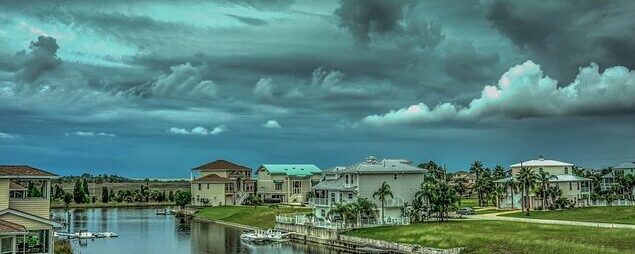
One inch of rain is equal to 27,154 gallons per 1 acre. South Florida has an annual precipitation of 61.3 inches per year. That is an average of 1million 600+ gallons a year for our lawns. Our sprinkler systems use 12 gallons per minute. This works out to 2160 gallons of water a week for 3 hours of sprinkling, with an average of 112,000 gallons a year per household. Most the lawns in South Florida are over watered. Using Sustainable Sprinklers patented smart system saves water, money and our drinking water.

Keeping Lawns Green

Run-off pollution occurs with each rainfall when water flows over land picking up soil and grass clippings and depositing them in streams, ponds, wetlands, lakes, and rivers.

In Florida at least once a year we see major water blooms and algae growth in our water ways. Run-off pollution is the major cause of this. And in many of these areas, it affects our tourism but even more importantly our drinking water.

Sprinkling your lawn correctly, and making sure that you are not over watering is the most important way to help minimize run-off pollution. Another way to help is called Grass cycling.

To Grass cycle correctly is for you or your landscaper to leave your grass clippings on your lawn after each time it is mowed. Also make sure that you sweep all clippings off of any concrete or porous area onto your lawn. Never air blow your lawn as all of the grass clippings will end up in the rain run-off and into our waterways. Grass cycling is also healthy for your lawn because as the clippings decompose they are filled with nitrogen, fertilizer and mostly water. Leaving grass clippings will not turn your lawn brown and will also help the clipped grass be out of South Florida direct intense summer sun.

Using a patented product from Sustainable Sprinkler for your lawns sprinkling needs is a great way to start saving money, water and electricity. Speaking with your landscaper about not blowing your lawn and grass cycling will help with our rain fall run off. Hopefully by watering our lawns correctly and doing some other little things, we can save and conserve our water.

The Rainy Season

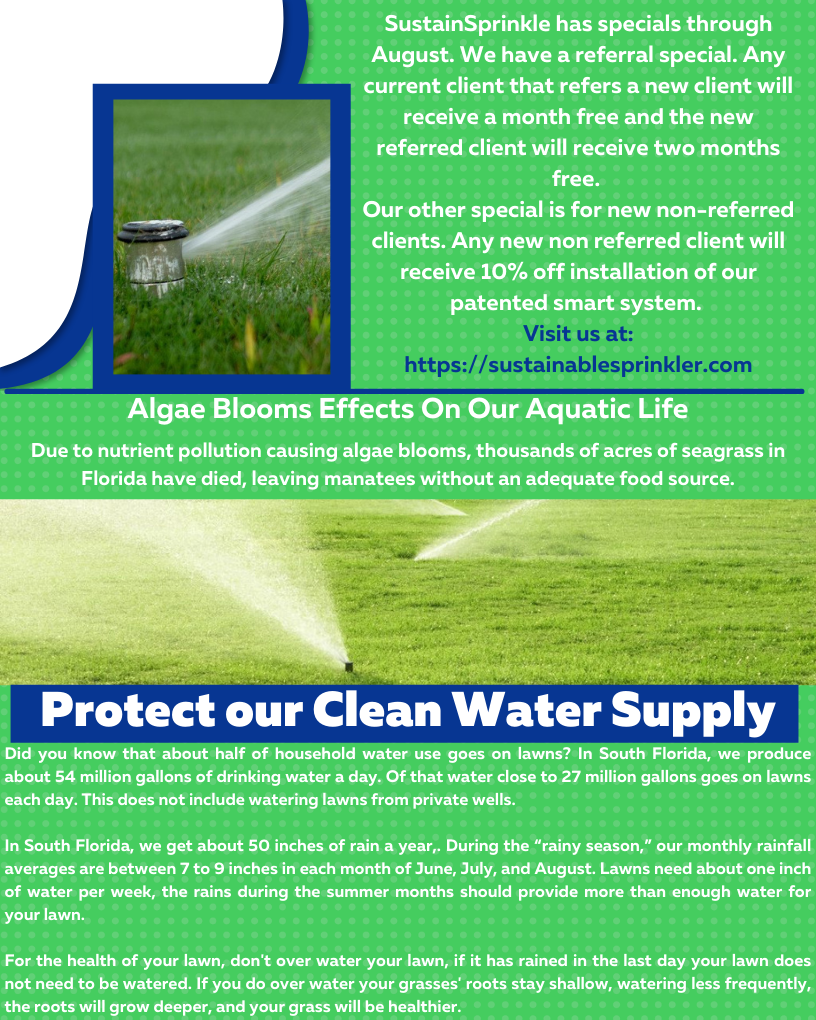
Did you know that about half of household water use goes on lawns? In South Florida, we produce about 54 million gallons of drinking water a day. Of that water close to 27 million gallons goes on lawns each day. This does not include watering lawns from private wells.

In South Florida, we get about 50 inches of rain a year,. During the “rainy season,” our monthly rainfall averages are between 7 to 9 inches in each month of June, July, and August. Lawns need about one inch of water per week, the rains during the summer months should provide more than enough water for your lawn.

For the health of your lawn, don’t over water your lawn, if it has rained in the last day your lawn does not need to be watered. If you do over water your grasses’ roots stay shallow, watering less frequently, the roots will grow deeper, and your grass will be healthier.

Run Off

During the summer months, Florida has “the rainy season. During this season on average 65-75% more rainwater will be saturating your lawn. While a large amount of rainfall on your lawn might be good for some of your plants, the overflow of water that flows off your lawn is toxic to our canals, rivers, lakes, and wetlands.

High levels of phosphorus are naturally found in Florida’s soil. An important thing to understand about Florida’s soil is it is naturally high in phosphorus. This is significant to be aware of as (blue-green algae) toxic water blooms are formed by high concentrations of Phosphorus in the canals, lakes, rivers, and our drinking water. The blooms produce toxins that affect our drinking water and at certain levels, this water is harmful to humans and our aquatic life.

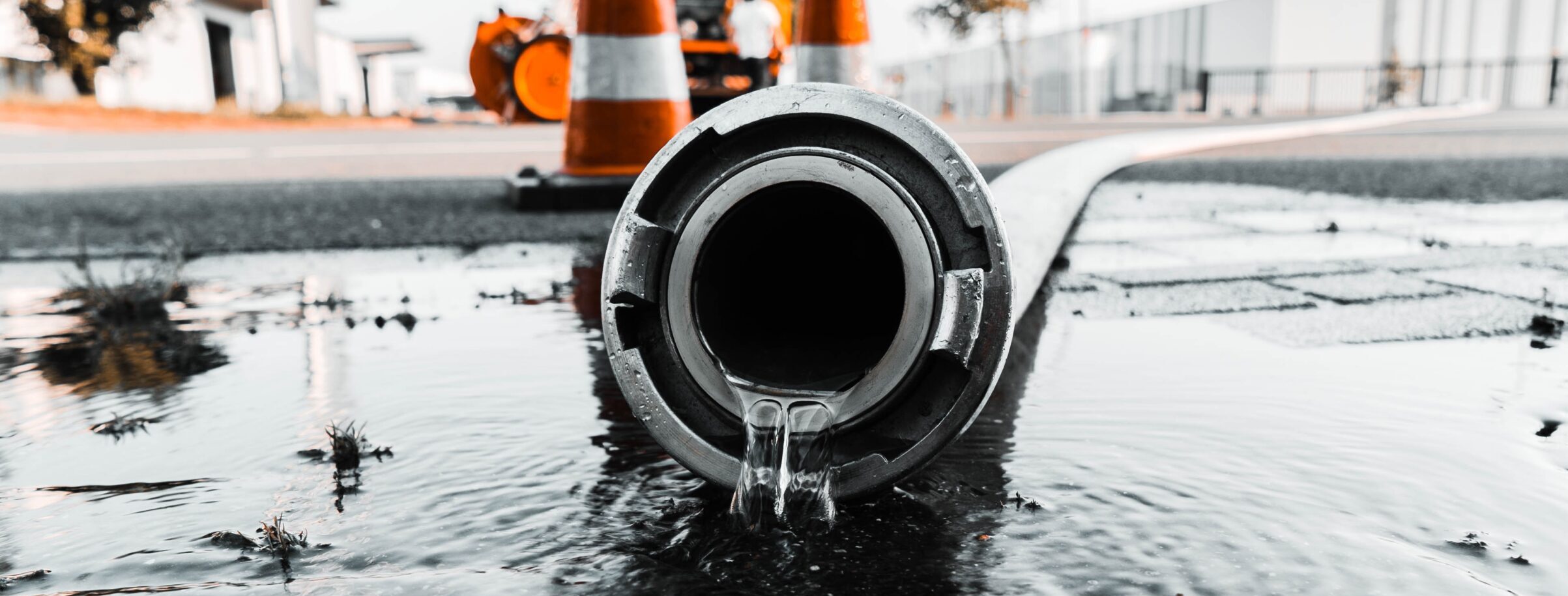
Storm water runoff is the water that cannot be absorbed by your lawn and plants. This water goes directly to the closest body of water. Not only is this water contaminated with fertilizer but also grass clippings. This makes the potential for water blooms to increase significantly.

To reduce storm water runoff, the most effective thing you can do is to water your lawn correctly. You will be doing more harm to your lawn and most importantly to our environment if you sprinkle the day of or the day after a rainstorm. Doing this helps our environment, saves water, saves electricity and saves money.

FACEBOOK

At Sustainable Sprinkler we have been doing a lot of interesting things this month. We will be sending out multiple emails every month. We are excited about our new email campaign and we know that you will find valuable information. 

Sustainable Sprinkler is now on Facebook. Please check out the page, follow and like. We will be posting at least three times a week about what we are doing within our communities, helpful information and quick updates. Please feel free to share our link with friends family and anyone that would be interested in what we do and our products.

PROTECT YOUR SOIL

Soil type, field slope, and flow rate all affect surface irrigation erosion, with flow rate being the main factor that can be managed. Ideally, sprinkler irrigation will have no runoff, but application rates on moving irrigation systems can exceed the soil infiltration rate, resulting in runoff and erosion